Choosing and knowing the audience – Who are we doing this for?
Updated 18 Oct 2026
Audience = the people a publisher chooses to serve
- AI makes an audience of one possible. Decide whether you serve a public, individuals or both, and what they need that AI cannot give them.
- Your target audience is not everyone. Many publishers inherited theirs from print and never made the decision.
- Describe people by their needs more than by demographics, although age still counts.
- Learning never ends. Keep the research running and get it to the newsroom, so it doesn't end up in a slide deck.
If you put the user at the center of it, in theory the rest of it should fall into place.
— Jennifer Hicks, The Wall Street Journal
Defining the audience
The audience is the people a publisher chooses to serve. Defining it means deciding who to serve and learning what they need, and the learning never stops.
Many legacy publishers never made that choice, at least when the shift to digital happened. They inherited their audience from print, where the strategy, in the words of the Table Stakes manual, was "general news for general audiences," and little was needed in the way of understanding any particular audience. Newsrooms worked out "what's the story" inside their desks and beats, and only then, perhaps, gave thought to the audience. That order needs to be flipped. Audiences come first, and then the content that serves their needs.1
The newsrooms in this project describe their audiences in very different ways. Two of them are after the same trait. The New York Times defines its target reader by curiosity, not by demographics.
We set our audience targets not by aiming for a set of demographic characteristics but by a number of psychographic measures. It's something we've called the "curious reader." These users are lifelong learners, they're travelers, and even when they play digital games, they want that time to be enriching and well spent. This rubric, the curious reader, is a better shorthand for our target audience than a particular geography or age group.
Anna Dubenko, The New York Times
Zetland began with curiosity too, and then got more specific.
For the first five to seven years of Zetland, we were just saying our target group is curious people everywhere. Which is still true, because of course everyone is welcome. But at some point a couple of years ago, we thought it was necessary to narrow it down a bit.
Sofie Flagstad Hansen, Zetland
A regional newsroom never had a single audience to begin with.
Most publications, I don't think, have a monolithic audience where everyone shares the same characteristics, unless you're a trade publication. Certainly not a regional news organization covering an area of five million people. We don't have a singular audience. There are multiple audiences.
Ross Maghielse, The Philadelphia Inquirer
One audience, many names
Newsrooms talk about readers and audiences, product teams talk about users, and Zetland talks about its members. Yle, Finland's public broadcaster, draws a line between the audience and the customer.
First of all, our audience is all Finns. Our customers are the ones who use our services logged in.
Anu Vilkman, Yle
The word affects who accepts the idea. When The 19th built its own version of the user needs model, it changed one word.
We just call it audience needs, because I found that's more approachable for journalists than saying user. They think of that as products, but it's the same thing.
Alexandra Smith, The 19th
However differently they put it, each newsroom is answering the same three questions.
- Who do we serve, and why?
- What do they need, and can we serve them?
- How do we learn who they are and what they need, instead of guessing?
The arc of choosing and knowing the audience
Pre-digital era (through 1994). The newsroom imagined its audience, and the business side measured it. A Tow Center report on how journalists imagine their readers goes back to the newsroom studies of the 1970s.2 When Herbert Gans asked journalists in four major newsrooms who they were writing for, "they always began with their superiors, and some went no further." Robert Darnton, a reporter at The New York Times in the early 1960s, recalled that editors expected reporters to aim their stories at "an imaginary twelve-year-old girl," who "merely functioned as a reminder that we should keep our copy clear and clean." The business side knew its readers as a demographic profile to sell. In the 1970s, newspapers cut back their circulation efforts among low-income and minority readers. As James Squires wrote, by doing so newspapers "actually improve the overall demographic profile of their audiences, which they then use to justify raising advertising rates." Where an audience was chosen, it was chosen for the advertisers.
The model reader
The concept of the Model Reader was introduced by Italian novelist and philosopher Umberto Eco in his 1979 book Lector in Fabula.3 According to Eco, a text only comes to life if the reader has the competence to interpret it, a body of knowledge he calls the encyclopedia. The Model Reader is an ideal reader the author designs into the text, with the knowledge to fully understand the intended meaning. This idea can be seen as an early version of audience-centric thinking.
Early web era (1995–2005). Publishers did not start to gather information about demographics because they wanted to understand their audience. They wanted to attract the advertisers. For the first time, readers could be asked who they were, one by one. When NYTimes.com launched in January 1996 it asked readers to register, and by July 1997 1.7 million had given their gender, age, income and zip code. The site sold advertisers targeting by those answers, at a 25% premium over untargeted ads, when CPM of untargeted ads on the site ranged from $20-50. In December 2001 the form grew to ask for year of birth, job function, industry, income and whether the reader also took the print edition, so that the site could "offer more effective targeting capabilities for our advertisers."
Media habits changed on many fronts. The share of Americans who watched only nightly network and local television news fell from 30% in 1993 to 15% in 1998, in only five years. The report also reveals the user needs of 1998, as more than 60% of internet users went online for news about health, science and technology. More than half (52%) went online to get financial information or to trade stocks or bonds.
The fickle mood of today's news consumer is further illustrated by the fact that over half of Americans watch the news with a remote control in hand.
Platform era (2006–2018). We had arrived in a high-choice media environment, where you did not need to watch the whole newscast to see the sports results. Analytics showed newsrooms what people actually chose, and it was not what the newsroom put first. Exploring the "news gap" between the supply and demand of information, Pablo Boczkowski and Eugenia Mitchelstein studied more than 50,000 stories on the 20 leading news sites in seven countries between 2007 and 2009. Journalists treated public affairs (national, international and business topics) as the most newsworthy subject, while the public gravitated towards sports, crime, entertainment and weather.4 The gap held across regions, and it narrowed during heightened political moments such as the 2008 US presidential election.
Newsrooms now also knew the questions that led users to their platforms, revealing what they were actively seeking as well as what they clicked on.
For as long as users are using search engines to understand the news, it's a very valuable channel. News organizations ignore or dismiss search users at their own risk. What could be more valuable than a reader who is actively signaling that they are looking for news? If they arrive through search, it means they chose you over a competitor.
Anna Dubenko, The New York Times
The reader also became one person. A newspaper subscription served a household, but a phone belongs to its owner. It took eight years from the launch of the iPhone for the Reuters Institute to call the smartphone "the defining device for digital news" and "this crowded and very personal device." By then a quarter of its respondents used a smartphone as their main device for digital news, and among those under 35 the share was 41%.5
Personas
Personas came from software design. The Computer History Museum credits Alan Cooper with inventing them in the 1990s, among the tools that are now standard in user experience. As the Lenfest Institute describes them, personas are semi-fictional profiles of audience segments. Newsrooms build them from surveys, focus groups and interviews with readers, and give them names, photos and goals. Not everyone in the newsroom is convinced by the persona approach.
It's probably too narrow. I'm sure it is useful, especially for marketing, but I think it's too narrow of a way to think about audiences.
Jennifer Hicks, The Wall Street Journal
Post-platform era (2018–2023). When readers started to pay, the audience stopped being an inventory to be sold to advertisers and became the business itself. By 2019, 69% of the newspapers the Reuters Institute followed in the US and Europe ran some kind of pay model, up from 64.5% two years earlier.6
Without an audience, we don't have a business.
Sarah Marshall, Condé Nast
The question moved from who the readers were to what they needed. At The New York Times, that work was called Jobs to be Done.
We used the Jobs to be Done framework. We did a big project about it in April of 2020. It helped inform many product decisions, such as how we built our live coverage. One example of the "job" we want people to "hire" The Times for is quite simple, but it's a useful framework: "Catch me up quickly."
Anna Dubenko, The New York Times
User needs
At the BBC World Service, digital development editor Dmitry Shishkin's team sorted stories by six user needs: update me, give me perspective, educate me, keep me on trend, amuse me and inspire me. The language services had stopped growing as competitors overtook them, and the aim was to reach younger audiences with something local publishers did not offer. When the team analysed three months of content, BBC Russia was producing 70% of its stories as "update me", while those stories brought only 7% of its page views. The current version of the model, User Needs 2.0, has eight needs in four groups.
AI-discovery era (2024–now). As AI has shaken the information ecosystem, some basic values, such as trust and being able to identify with the source, have become even more valued. Publishers really need to stay on top of their game, monitoring the changing values and behaviour of their audience. In its 2026 report the Reuters Institute found that more than a quarter of its global sample (27%) get information each week from news creators. In the United States, people who get all or most of their news from creators were three times as likely as the general population to say news from creators is more trustworthy than mainstream media. In France, 18–24s saw creators as more authentic, more knowledgeable and more trustworthy.7 In the US, Pew found that 31% of those who regularly get news from influencers feel a personal connection to one. AI answers also borrow their trust from the newsbrands they cite. In a UK survey for the Association of Online Publishers, answers citing a completely trusted newsbrand were trusted by more than 90% of respondents, against about 10% when the source was completely distrusted.
In 2024 the Reuters Institute put the user needs model to the audience itself, asking people in 47 markets which needs mattered to them and how well the news media met them. People rated "update me" (72%), "educate me" (67%) and "give me perspective" (63%) as the most important needs, and "divert me" (47%) as the only one that fewer than half consider important. Understanding came out as the top priority for improvement. Just over half (55%) thought the news media do a good job on it. In the report's words, "few want 'just the facts.'"8
AI also gave small newsrooms a way to read their own audience research. Outside journalism, the social scientist Stefano De Paoli tested a large language model on interview data that human researchers had already analysed. The model could infer most of the main themes the humans had found, though it reproduced their method only in part.9 The study was made using GPT-3.5, though, so more recent LLMs are most likely already more capable.
I do use AI to analyze our qualitative audience data. That's making it a little easier to do the data work that informs audience engagement.
Alexandra Smith, The 19th
Putting a chatbot in a publisher's own news product has been a somewhat logical first use case for customer-facing AI features. Not that there are many success stories about engagement with them, but the insight into what people are asking is seen as valuable. In 2025, four small newsrooms in the US Southeast ran chatbots for 45 days, built with the University of North Carolina's Center for Innovation and Sustainability in Local Media. Readers asked only 185 questions. At The News Reporter, a weekly in North Carolina, the help desk bot could answer more than 90% of what readers asked, such as how to manage a subscription or submit an obituary, because the answers rarely changed. Questions that needed fresh information, like "What's the latest story?", were harder. Each bot answered from its own knowledge base, and the bots whose knowledge base did not update automatically often could not answer them. Overall, about a third of the conversations ended with "I don't know." Still, the center called the logs "valuable insight into what audiences expect."
Individual initiatives also give signals of what might be ahead, and AI might popularise the idea of an "audience of one". Lisa AI, made by two 23-year-olds in Argentina, asks users to pick topics and say how much each interests them. It then scans dozens of Argentinian news outlets and turns what it finds into a 10-minute spoken newscast that credits the outlets. Weeks after its August 2026 launch, it was the top news app in Argentina's App Store, and about 80% of its users came back the next day. It was not built by a publisher.
What the arc shows
For most of this history, knowledge about the audience served the advertisers. Circulation figures and registration forms described readers so that their attention could be sold. When it began to look inevitable that digital subscribers were the key to a sustainable future, data showed why they came in the first place, and many newsrooms opened their doors to audience insights.
The gap between what the newsroom offers and what the audience wants keeps reappearing in new forms. It goes without saying that it is a sign of a good journalist that they are resistant to outside pressure. Still, Gans's studies from the 1970s reveal that audience research was often rejected because journalists were "reluctant to accept any procedure which casts doubt on their news judgment and their professional autonomy." Boczkowski and Mitchelstein found the gap in topics. Between 2007 and 2009, journalists on 20 news sites put public affairs first, while readers clicked on sports, crime and entertainment.
The unit of audience kept shrinking, from a circulation area to a household, from a household to a person with a phone, and now towards an audience of one. Meanwhile what people value most in their news is trust, and a source they feel they know.
The questions underneath stay the same. Who do we serve, and why? What do they need, and can we serve them? How do we learn who they are and what they need, instead of guessing? Every era answered them in its own vocabulary, from the twelve-year-old girl to the curious reader, from public affairs to "catch me up quickly." Choosing comes first, and learning never ends.
Audience research
Audience research began on the business side. The New York Times surveyed a reader panel for about two decades, on questions such as which sections people read, before its results were first used for journalism in 2015. By 2016 a user experience researcher, Emily Goligoski, was working directly with editors, and her first project asked what readers needed during breaking news.
Today research has a team of its own, working next to the newsroom's audience team.
We have a team called Audience Insights Group. They are qualitative researchers who administer focus groups and surveys that help us see what the behavioral data (pageviews, time spent) can't quite show us. This group is also responsible for our market sizing, and longitudinal studies about how our brand is perceived.
Anna Dubenko, The New York Times
The Atlantic's audience research team began building a list of reader needs in autumn 2019 and was still validating and refining it in early 2022. It drew on surveys and interviews with current, former and prospective subscribers and with listeners of its podcasts and narrated articles. Over two years, readers' answers to why they spent time with The Atlantic barely changed. Editors used the five needs, such as "give me deeper clarity and context" and "let me take a meaningful break," to plan The Daily newsletter and the Today feed in the app, and the growth team used them for marketing emails to prospective subscribers. The team expected the list to adapt as the audience's needs change.
When it comes to user needs, there are reasons why audience research needs to be done by market, and often by brand. At BBC Russia, 70% of the stories were "update me", but they brought only 7% of its page views. By contrast, in 2024 the Reuters Institute found that "update me" was the need most often rated important (72%), and that understanding was the need the news media most had to improve. People don't always do what they say. No one said audience research was easy.
Keskisuomalainen publishes 57 subscription titles. Sami Hannukka, its consumer sales and marketing director, described a segmentation study across the group's region that found six segments. The group chose three, split its two growth segments into six personas and deliberately aimed them at people under 45, even though the segments themselves were not defined by age. The segments could not even be matched to the existing subscribers, who were too much alike to tell apart. Then the personas had to work in the newsroom.
We noticed quite quickly that six was perhaps a bit too many for content production in its hectic daily routine. So we condensed the six personas once more into, in practice, three groups.
Sami Hannukka, Keskisuomalainen
Segments and needs
Several of the newsrooms I interviewed divide their audience in more than one way, and which one counts depends on the team. At The Atlantic, several models have been in use within a couple of years.
There are a lot of ways to segment audiences at The Atlantic. We've done a lot of different things in the past couple of years. We've had personas. We have this other definition around future subscriber segments, which our audience research team came up with, which is a lot more about who could be potential Atlantic users. But I think the reader state model has been the most adopted by most of the organization.
Mariah Craddick, The Atlantic
At The Wall Street Journal, the line runs between marketing and the newsroom.
The marketing team might have more specific cohorts or personas, but in the newsroom, we think more in terms of user needs. Who needs what from our journalism? How do we meet those needs at this moment?
Jennifer Hicks, The Wall Street Journal
Demographics have not disappeared. Age keeps coming back, as with Keskisuomalainen's personas for people under 45, while other characteristics are harder to justify.
I think age definitely is top of mind when it comes to demographics. Otherwise I think any other demographic targeting starts to get a little bit ethically, a little bit questionable. So we try not to lean too much on demographic data, but it is something that we're thinking about when it comes to age and making sure we're relevant to more people.
Mariah Craddick, The Atlantic
The 19th still measures demographics but has moved its planning to needs.
I don't think we're only serving people's needs by focusing on their identities. Historically, I would say it was pretty demographic segment type framing, and we've shifted now to more of this audience needs model.
Alexandra Smith, The 19th
In 2025 Aftenposten in Norway described how it brought demographics and needs together. Its data scientists clustered the whole user base, and the newsroom interviewed readers. The four segments that came out were first defined by age and gender, and each was given a name and a need. The analyst, older men, wants to understand "how societal questions are connected, both nationally and internationally." The sporadic, younger women, wants "an overview of the most important news" to bring into conversation. Aftenposten meets regularly to see how each story did in each segment, and its war coverage now gives more room to families and daily life than to troop movements. Its director of product and UX wanted the segments to work for every department.
Create definitions that help you classify and quantify content performance and audience reach consistently, and ensure that it becomes a lens of analysis available to all departments across the organisation [not something only used in product, commercial, or newsroom].
Karl Oskar Teien, Aftenposten
Younger audiences
Age shapes why people follow the news more than nationality does. A University of Navarra study of more than 45,000 people in 23 European countries found that national context did little to explain people's motivations, while age was "a far more influential factor".10 Young and older people were equally likely to say they follow the news because it is a citizen's duty. The young, aged 18 to 35, had weaker ties to news brands, preferred video and used news more for personal growth, entertainment and social purposes. Their needs differ less. In the Reuters Institute's 2024 survey, younger people gave a little more weight to "inspire me" and "divert me", but the basic hierarchy of user needs stayed the same.8 At The Atlantic, the weaker ties show up among subscribers.
Our average subscriber age has only gotten older, and we actually have lost ground with younger subscribers. Some of that we think is due to our consumer strategy. We've increased our prices. We're a lot more hard gated. Younger people in general can't afford to subscribe, but we haven't really done anything to meet them where they are. When something does go viral, we see it resonate with younger people, but to make the leap to actually becoming a fan and coming to our platforms and signing up for newsletters and then subscribing, we don't see that happening.
Mariah Craddick, The Atlantic
In interviews, professionals shared mixed views about whether and how to engage Gen Z. Several noted that reaching younger audiences requires formats and skills that many current newsrooms lack. The 19th, which aims at readers over 30, has chosen to wait.
We intentionally aren't trying to reach younger audiences, like Gen Z. There's certainly people in that age segment that could or would be served by The 19th and are interested in it, and a small group of people do find us. But we are not set up with the skills or capacity to develop journalism in the formats that they prefer right now.
Alexandra Smith, The 19th
The future of choosing and knowing the audience
What is the role of mass media versus the audience of one? What track can a publisher take in an algorithm-powered ecosystem? Is a media company yet another surface that offers comfortable bubbles, or can it create shared experiences? AI has made it cheap to build a news service around a single listener, as Lisa AI did in Argentina. Yle's goal is to hold on to both.
Personalisation is Yle's main focus this year. "Shared by all, and one's own for each." The idea is that we would have the right content at the right time. Half of our news front page is still laid out by hand, and the other half runs on recommendation algorithms. We're not heading for any massive personalisation. It's quite a small share that may get personalised, but the point is that the experience would be better and more relevant at the moments when people come to the service.
Anu Vilkman, Yle
For anyone preparing for the future, audience behaviour, changing needs and the alternatives that technological evolution creates are the hardest things to predict, but eventually those are the factors that dictate the trajectories journalism takes. Researchers at the Universities of Helsinki and Tampere asked a small group of Finnish media professionals to react to scenarios of an AI-powered news ecosystem in years to come.11 They came from public service media, a news agency, a major newspaper and start-ups, among others. They mostly expected AI to deliver speed and sensemaking, and to answer the demand to choose the format they prefer, whether text, audio or video. They did not expect it to meet the needs for local information, access to decision-makers, trust, and "humanity, authenticity", and they disagreed on whether it could be accurate enough. The need for content made for a mass audience was seen as declining. The study's lead author put it more bluntly to Suomen Lehdistö.
The strong underlying note is that the future of chasing a mass audience looks problematic. All the other paths take shape, to some extent, in contrast to it.
Henrik Rydenfelt, University of Helsinki
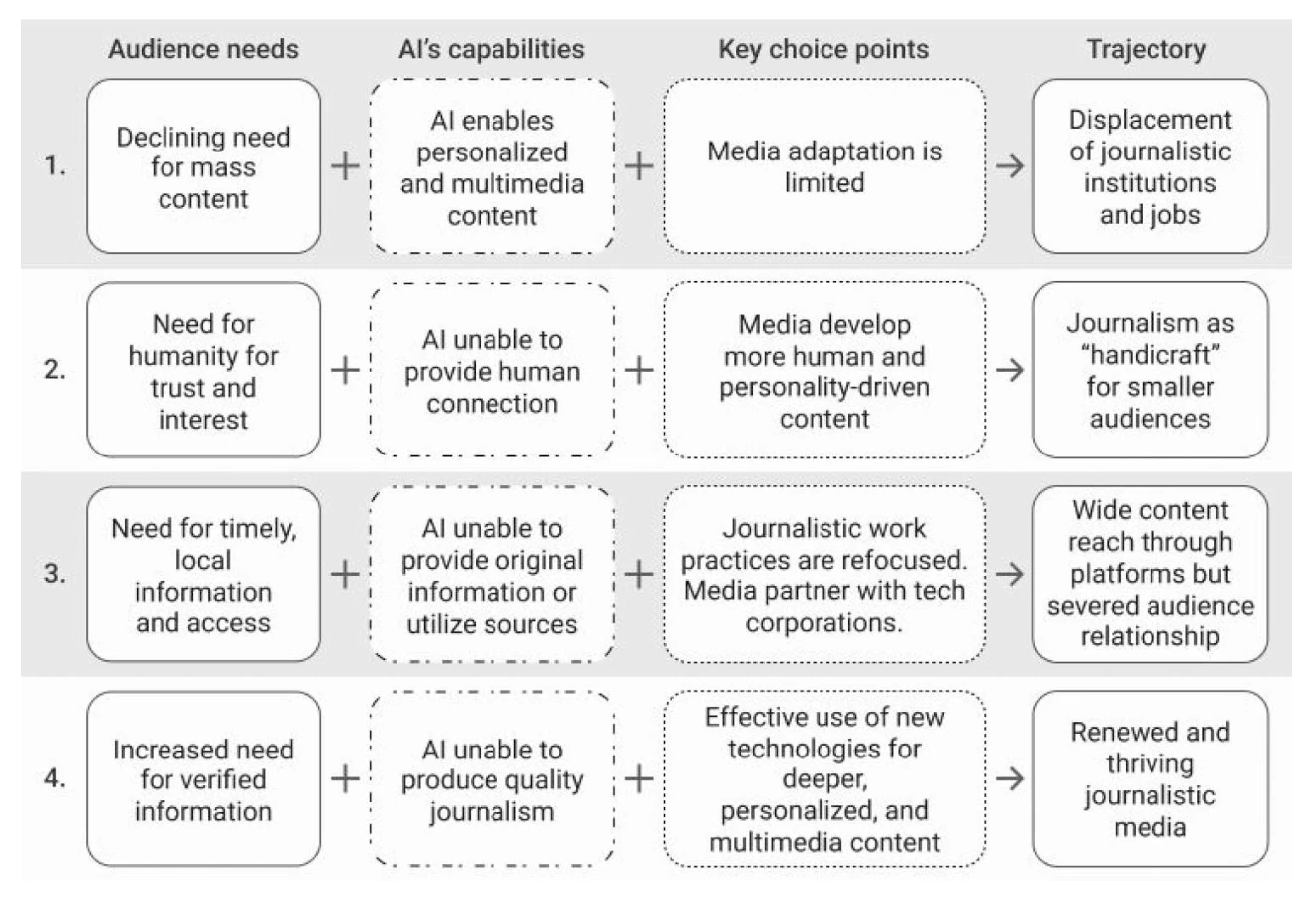
Four possible futures for journalism, from displacement to renewal. Each follows from a change in audience needs, what AI can or cannot do, and the choices media make. Figure 7 from AI in Media Consumption: Charting the Futures of Journalism, Henrik Rydenfelt, Joel Kiskola and Thomas Olsson, Journalism Studies 27, no. 8 (2026), p. 1169. © 2026 The Author(s). Published by Informa UK Limited, trading as Taylor & Francis Group. Licensed under CC BY 4.0. No changes made.
The study names one fork in particular, between personalised media and content made for a mass audience. The researchers see two starkly contrasting ways to respond. One is to embrace AI-driven personalisation and formats tailored to each person. The other is to put human interaction first, as a source of trust, and keep a close relationship with the audience. Some participants pointed out that "not everyone desires such personalization," and one said the last thing they wanted was "more algorithmically curated stuff." The researchers stress that the trajectories are not predictions, and that a small group of participants in Finland, with largely shared backgrounds, limits the view. At The Atlantic, editors still choose almost everything readers see.
Almost everything is curated by the editorial teams. I think there's definitely a bias at The Atlantic for editorial curation, for a lot of good reasons. The Atlantic prides itself on exposing people to various viewpoints and not just siloing you into what information you see. That's what they lean towards right now, but there's also some experimentation we're doing with personalization at the same time.
Mariah Craddick, The Atlantic
AI could also change how a newsroom gets to know its audience. Looking ahead to 2026, The Wall Street Journal's director of newsroom data and AI predicted a new kind of focus group.
Publishers will use synthetic audience models – AI chatbots trained to embody key audience personas. These "always on" sounding boards will deliver reporters and editors instant feedback. Do you want to chat over an idea? Check if your lede hooks your target reader? Just ask your (AI) audiences.
Tess Jeffers, The Wall Street Journal
The Times in the UK had already tried it. Working with Electric Twin, it built an AI simulation of a reader panel drawn from its 642,000 subscribers and used it to test names for a business podcast. The panel's favourite, The Business, became the title. The publisher says the simulation was about 92% accurate when checked against a holdout group of its own readers.
Writing in The Audiencers, audience consultant Khalil Cassimally sees synthetic audiences helping with common pitfalls in audience research, where feedback is consulted only after instinct has already decided, or the study ends up buried as a slide deck on a drive. Looking at the research, he finds that synthetic versions of people built from long interviews reach roughly 85% of the human benchmark, which is how consistently people repeat their own survey answers two weeks later. What a panel stands on, he writes, "sets the ceiling on everything after it." He ranks the grounding in three levels, from nothing, to demographics, which are "still a description of a category rather than of anybody," to real material from real readers. His tips point to where the method is most useful, in testing language, narrowing options, surfacing objections nobody had thought of and comparing how different groups react to the same thing. A panel, he warns, "shouldn't speak for communities we haven't spoken to."
Are these the questions for the AI era?
- Who do we serve, and why, when AI can build a news service around a single person?
- What does the audience need that AI cannot give them, and can we serve that?
- How could we learn more from real people, when a synthetic panel answers in seconds?
Take it further in the Toolkit
The Defining Audience chapter gathers the models leading newsrooms use to describe who they serve. User needs plans coverage around what people want from a story, from being updated to being inspired. User personas turn research into archetypes a newsroom can remember. Psychographic segmentation groups readers by values, attitudes and lifestyles rather than by age or income. For further reading, see Top resources.
Footnotes
-
Douglas K. Smith, Quentin Hope and Tim Griggs, Table Stakes: A Manual for Getting in the Game of News (CreateSpace, 2017). https://betternews.org/serving-targeted-content-targeted-audiences-table-stakes/ ↩
-
James G. Robinson, The Audience in the Mind's Eye: How Journalists Imagine Their Readers (New York: Tow Center for Digital Journalism, Columbia Journalism School, 2019). https://www.cjr.org/tow_center_reports/how-journalists-imagine-their-readers.php ↩
-
Umberto Eco, Lector in Fabula: La cooperazione interpretativa nei testi narrativi (Milan: Bompiani, 1979). ↩
-
Pablo J. Boczkowski and Eugenia Mitchelstein, The News Gap: When the Information Preferences of the Media and the Public Diverge (Cambridge, MA: MIT Press, 2013). ↩
-
Digital News Report 2015 (Oxford: Reuters Institute for the Study of Journalism, 2015). ↩
-
Felix M. Simon and Lucas Graves, Pay Models for Online News in the US and Europe: 2019 Update (Oxford: Reuters Institute for the Study of Journalism, 2019). ↩
-
Digital News Report 2026 (Oxford: Reuters Institute for the Study of Journalism, 2026). ↩
-
Digital News Report 2024 (Oxford: Reuters Institute for the Study of Journalism, 2024). ↩ ↩2
-
Stefano De Paoli, "Performing an inductive thematic analysis of semi-structured interviews with a large language model: An exploration and provocation on the limits of the approach," Social Science Computer Review 42, no. 4 (2024): 997–1019. ↩
-
Mónica Recalde, Alfonso Vara-Miguel, Jorge del Río Pérez and Cristina Sánchez-Blanco, "Exploring news gratifications across age groups: A European study in 23 countries," European Journal of Communication 40, no. 1 (2025): 70–86. https://doi.org/10.1177/02673231241309574 ↩
-
Henrik Rydenfelt, Joel Kiskola and Thomas Olsson, "AI in Media Consumption: Charting the Futures of Journalism," Journalism Studies 27, no. 8 (2026): 1151–1174. https://doi.org/10.1080/1461670X.2026.2627469 ↩